Archive

democracy

Those of us who have been pulling for the General Motors strikers might begin today to evaluate what we have learned.

  • Striking can pay off in the current economic and political situation
  • General Motors employees showed incredible gumption
  • Union solidarity is terrific
  • Public solidarity with union members is rising
  • Union-busting can be beaten
  • We could have done a lot more than we did
  • The American people are learning which side they are on and what to do about it

On the day before voting is supposed to end, it looks like at least a 60% ratification vote. 

That’s Courage!

There’s a lesson right there. Apparently, 40% of the union members were willing to continue the strike beyond its 6th week! Being on strike is really, really hard! Whether one agrees with them or not on the contract, one surely must concede that they really have guts!

The contract summary is on http://uaw.org. Some of the newspersons have written that it comes up short in providing job security and in bringing the “perma-temps” into full-time employee status. But the people who actually know what they’re talking about consider it quite a victory.

We Win! 

The top American union leader, AFL-CIO President Richard Trumka, wrote:

“I’ve never felt prouder to be a union member. Backed by millions of brothers, sisters and friends across the country, UAW members stood together to win the fair treatment that they’ve earned over years of selfless sacrifice. I commend the UAW’s national negotiators for standing firm to deliver on what their members demanded and hope this will bring an end to one of the most courageous fights I have ever seen. This is the latest victory in a wave of collective action happening across America. Working people won’t allow greed to dictate our lives, and we won’t tolerate a system that’s been rigged against us. Bosses everywhere should take note—we’re not going to take it anymore.”

On the picket line on day one, it was like a carnival! There were any number of people who were not UAW strikers. Some were from other unions, but some were not union members. Many of the passing cars honked approval.

Social media started spouting all kinds of solidarity messages. Some of them came from the union, but a lot of them were home-made. Political office holders and candidates started posting “I stand with the strikers” and proud pictures of themselves on the picket lines. Several presidential candidates were among them.

A lot of people were asking how they could help. Cases of water were stacked up. People brought cookies and other snacks. In my area, one AFL-CIO unit started raising money to help strikers with financial problems through United Way. They weren’t asked by the union, and they didn’t ask the union. They just did it!

Yard signs of solidarity started going up, and lots of people were asking how to get one.

Beating Union Busting

The newspersons talked more about this strike than they usually talk about anything to do with the union movement. They completely missed the important part, though.

What they could have said was that the 2019 General Motors strike represented an all-out union busting effort by General Motors, other corporations, right-wing ideologues, and the federal government. The result was an historic victory for working families!

Most of the coverage came from two Detroit newspapers. Every article and opinion piece always included the government’s investigations of top UAW leaders on charges of corruption, money laundering, and embezzlement. Investigations had been going on for a while, but they really hit the news on September 15, when the strike began!

Writers on our side, people like me, didn’t talk about these investigations because we recognized them for what they are: union busting. They were hoping to divide the strikers from one another, from their leadership, and from their growing public support. Now that the strike is over, I expect the fanfare to fizzle.

We Could Have Done More

I am a long-time UAW member from the aerospace section. I did not expect the UAW leadership to utilize the lessons that won unprecedented victories for the teachers of West Virginia, Oklahoma, and Arizona. I hoped they would, but I didn’t expect it and, unfortunately, they met my low expectations.;

Basically, all the UAW leadership did was call a strike and set up the financial structure to pay the members who carried out their strike duties. What might they have done?

  • They could have organized their retirees and other supporters to join the pickets and carry out other solidarity actions
  • They might have suggested that supporters could carry out informational pickets at car dealerships
  • They might have had an ongoing union educational program for off-duty strikers
  • They might have had social events for strikers, and even for supporters

But, as far as I could tell, they didn’t.

Contrast the General Motors strike with the Chicago Teachers strike that started just as the autoworkers were winding down. The Chicago Teachers held a national solidarity day, today, in which everybody published selfies of themselves or their organizations. Their hashtag, #putitinwriting, will give them thousands if not millions, of contact information for supporters all over the world! If they should decide on expanding the strike or, for example, on raising money, they now have an incredible base of support!

If the Chicago School Board doesn’t cave soon, we are likely get a real lesson in modern fighting tactics from the Chicago teachers!

Summing Up

News coverage of the 2019 General Motors strike will continue to nit pick over the contract details. A few of them might discuss the strike tactics. But they will continue to miss the historic importance: The American people are ready to fight, and we are learning how to win!

–Gene Lantz

I’m usually on http://knon.org/workers-beat every Saturday at 9AM, unless a tornado destroys the studio. If you are curious about what I really think, check out my personal web site.
What Do You Have to Lose?

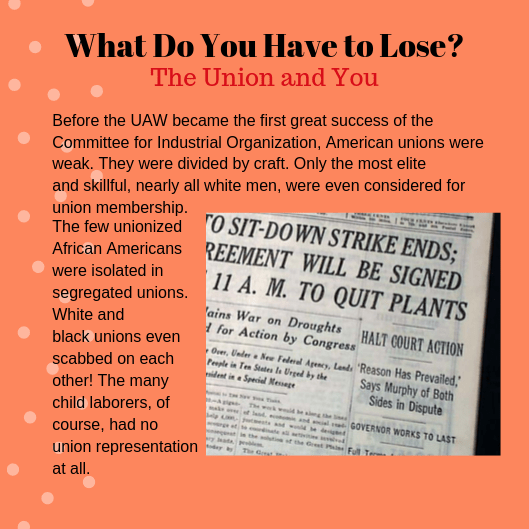
Today, while Corporate America, dark money, and an even darker government are trying to destroy the United Auto Workers, it would be good to consider what it means for all of us. To do that, look back in American history to a time before the UAW became the first great success of the Committee for Industrial Organization.

In 1935, nearly all American unions were weak. They were divided by craft. Only the most elite and skillful, nearly all white men, were even considered for union membership. The few unionized African Americans were isolated in segregated unions. White and black unions in the same workplace even scabbed on each other! The many child laborers, of course, had no union representation at all.

Color and gender lines were broken once and forever in the union. The UAW organized industrially. That is, everybody who worked in the industry was a candidate for membership. Their anti-discrimination pattern and their militant action were followed in the great upsurge that followed, and working people in America gained unprecedented power.

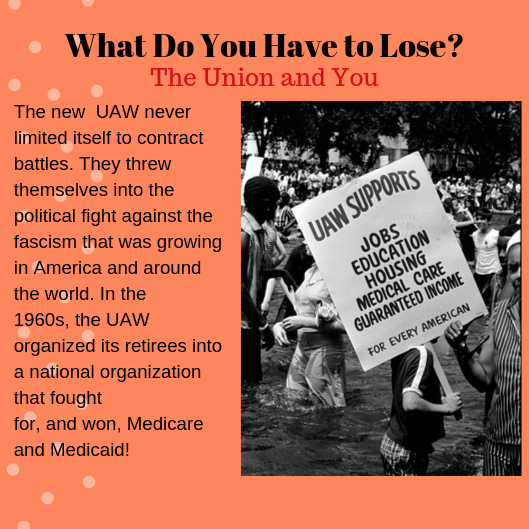
The UAW never limited itself to contract battles. They threw themselves into the political fight against the fascism that was growing in America and around the world. In the 1960s, the UAW organized its retirees into a national organization that fought for, and won, Medicare and Medicaid!

The explosion of worker power went far beyond improving wages and benefits. America’s civil rights also surged forward, and the UAW was more than just a great example to follow.

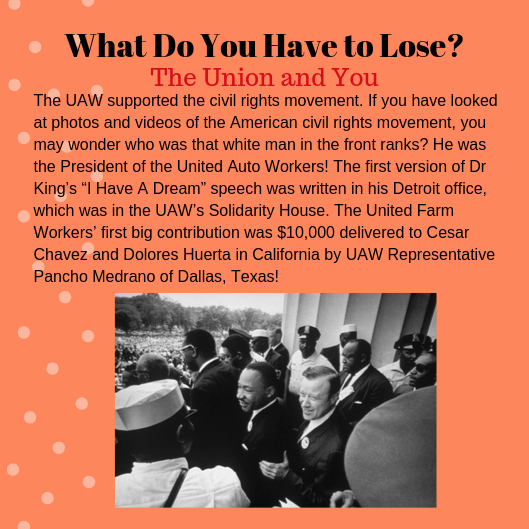
The UAW supported the civil rights movement. If you have looked at photos and videos of the American civil rights movement that began in 1954, you may wonder who was that white man in the front ranks? He was the President of the United Auto Workers! The first version of Dr King’s “I Have A Dream” speech was written in his Detroit office, which was in the UAW’s Solidarity House. The United Farm Workers’ first big contribution was $10,000 delivered to Cesar Chavez and Dolores Huerta in California by UAW Representative Pancho Medrano of Dallas, Texas!

Before the UAW, most American workers were no better off than day laborers. Corporate America has never forgiven the union for its part in bringing dignity into our workplaces. They would like nothing better than to destroy the UAW and the entire American labor movement. That’s why we have to fight!

–Gene Lantz

I’m on KNON radio’s “Workers Beat” at 9 AM Central Time every Saturday. They podcast on http://knon.org. If you are curious about what I really think, check out my personal web site

Yesterday, I met with a futurist researcher named Mike Courtney. He wanted to interview me, he said, for a paper he’s writing on “unions and automation.”

I gave Courtney fair warning. I told him that my views don’t represent anybody but me, but I have AN AWFUL LOT of opinions.


This futurist said that some automation is apparently “good,” but some of it is also “bad.” He wanted to try to find the line distinguishing “good” from “bad” automation. He figured a union man’s opinion would assist.

I told him that unions usually oppose automation, but we’re wrong when we do. As far as I can tell, unions either do nothing about automation or they try to negotiate with corporations to ease the pain when automation is inevitable. Good examples, I told him, were probably the Mine Workers and the Dock Workers on the Pacific Coast. I understand that both of them were decimated by automation, but not until after they had negotiated as good a deal as they thought possible. In my own local union, our Negotiating Committee Chairman once set up a “New Technology Committee” to try to advise negotiators what to do about automation. I consider that just about as good as any union does nowadays. At least they tried.

I could have told him that the machines I started running in 1978 replaced 16 conventional machines and, thus, 15 jobs. The machines that eventually replaced mine, as I retired, each replaced six of the ones I ran. Five more jobs lost to automation.

I did tell him what I did as an accountant. This was back before IBM introduced their 360 mainframe to take over jobs. I started a process of bill-paying that was all computerized. The machine compared what we thought we should pay with what the vendor was requesting. If they agreed, the bill was paid as soon as it was due. If they didn’t agree, then the accountant had to reconcile them and stick reconciliation data, positive or negative numbers, back into the machine. The machine just compared two sets of data and kicked out the ones needing reconciliation. I guess I would have seen the Accounting Department decimated if I hadn’t gotten bored and quit.

I think that Futurist Courtney was a little bit surprised when I insisted that unions were wrong to oppose automation. After all, I said, automation does what capitalism does best — lowering the unit price of the products we need or want.

The only problem with automation is how its benefit is allocated. Right now, all the benefit accrues to the capitalist in charge. Workers get nothing but layoff notices or, if they are lucky, they get to stay at work and do something even more mindless and boring than what they had before.

The automation genius of today is Jeff Bezos of Amazon. He has tens of thousands of employees worldwide. They do pitifully repetitious tasks and get paid very little. Besos, last I heard, makes $215,000,000 a day!

The solution to the problems that automation causes is not to oppose it. The solution is to grab some of the benefit. The way to do that is to shorten the working day every time productivity goes up. It’s the amount of wealth that an average worker produces in an average hour. Productivity is a statistic that the Bureau of Statistics gives out, I think, every quarter. It’s often around 2%.

Productivity aggregates, like a saving account aggregates. If you put the quarterly increases into a spreadsheet, you would see that an American worker today makes more than 4 times as much wealth in an hour than he/she did at the end of World War II. If the unions had known what they were doing, they would have demanded cuts in the working day so that they wouldn’t have lost 70% of their members, as they did.

The worst part about it, I told the futurist, is that union leaders figured this out long ago. From 1937 to 1947, the heyday of the Congress of Industrial Unions (CIO) they demanded “30 for 40 with no cut in pay” every time they negotiated a contract. It meant that workers should work only 30 hours a week but continue to get paid the same that they made in 40 hours.

My own CIO union, the Auto Workers, had resolutions for “30 for 40” in every convention up to 1957. Then it disappeared. If you asked union leaders today about cutting working hours, I don’t think they would know what you are talking about.

My friend Tom Berry knows. He does a forum in North Dallas every Saturday evening. And every Saturday evening he gets up and says that Americans should demand a 6-hour day. It works out mathematically, you see: instead of 3 8-hour shifts we would have 4 6-hour shifts. Unions would be bigger and periodic unemployment would be less of a problem.

There are other advantages, too. Some researchers think that shortening the working day, completely by itself and for no other reason, would increase hourly productivity. People would just do their jobs better.

Another advantage might be that people with more leisure time might create even better ways to improve our quality of life.

Historically, the fight for shorter hours defined our worldwide labor movement. Getting the Fair Labor Standards Act in 1935 was the best thing we ever did. It said that employers had to pay their blue-collar workers overtime if they worked us more than 40 hours in a week. That’s all it said, but it was great.

But shortening the working hours has passed completely out of our collective consciousness. Most of the workers in my union don’t even want shorter hours. They grab up all the overtime they can get, just to pay their bills. A major social change like shorter working hours just doesn’t seem real to them, and that’s the union’s fault. Automation is killing American labor, and we have no program to deal with it.

–Gene Lantz

I’m on KNON Radio’s “Workers Beat” talk show at 9 AM Central Time every Saturday. The podcast it on knon.org. If you are curious about what I really think, check out my personal web site.
I love my union dearly. The United Auto, Aerospace, and Agricultural Implement Workers of America (UAW) is largely responsible for some of the greatest leaps forward in the history of the American labor movement. But I’m terrified that we’re in trouble today.

Sing the union’s praise!

The UAW’s main contract, and one of the most important union contracts in America, expires September 14. They have decided to target General Motors then demand the same contract from Ford and Fiat/Chrysler. It’s called “pattern bargaining” and it has made the autoworkers some of the best-represented workers in American history.

Workers in Aerospace, like me, and other UAW-represented workers have done pretty well, too, but not as well as the auto workers. 151,000 of them face the contract expiration that looms over us right now. They voted by impressive margins to authorize strikes if the union negotiators decide it’s needed.

Trouble in the News

Just making everything worse, FBI and IRS agents are investigating the possibility of corruption at the highest levels. I believe 9 from the upper echelons of the union have already been convicted or pled guilty. It is fascinating to speculate on how people will react to this bad news.

I know how the Trotskyites of the 4th International feel, because I read several of their posts. They are full of glee. They call the union a “criminal conspiracy” and, apparently, can’t wait for more convictions.

A quite different reaction came from People’s World, a news service loosely associated with the Communist Party, USA. They aren’t happy with the news and want to minimize its effect on the contract negotiations. That’s my attitude, too.

Whatever some union officials may have done, if indeed they did, there’s no reason to penalize 151,000 ordinary workers for it. The government of the United States is clearly against working families, and hitting the headlines with their investigation during contract negotiations is clearly anti-worker.

UAW leaders haven’t said much to the public about the investigation. President Gary Jones has made it clear that they are focusing on the negotiations and trying to get the best possible contract. That’s exactly right, in my book.

Something Worries Me More

The UAW leadership hasn’t said a lot about the investigation, but that isn’t my main concern. What worries me to death is that they haven’t said much about the negotiations either!

I’ve been writing for some time about the recent upturn in some union activities. The most notable successes were the school employees in West Virginia, Oklahoma, and Arizona last year. But there are other, smaller successes, too. All of them involve mobilizing union members, their families, their friends, their churches, their community organizations, and even their political representatives.

Everybody who reads labor news knows that such broad mobilizations can win, and are probably the only possible way to win in today’s world. “Go it alone” is discredited. I don’t want to see the mighty UAW go alone into disaster, but I’m afraid that might happen.

So What Can You Do?

If the UAW leadership isn’t asking you for help, what do you do? All I could think of was to sound the alarm and start asking people if they would be willing to help when and if the union asks.

I made up a sort-of pledge that says, “We are backing the United Auto Workers union in negotiations with the auto industry. Many of the best things in American labor history came from the UAW. Standing with the UAW is standing for America!

Name, zip code, and contact information:

______________________________________________________ ______________________________

______________________________________________________ ______________________________”

I’ve given them out all over my area. Who knows if they will help? Who knows if they will ever even be needed? I can’t just stand by, and I hope you can’t either!

–Gene Lantz

I’m on KNON radio’s “Workers Beat” program at 9 AM Central Time every Saturday. If you are curious about what I really think, check out my personal web site

This morning, I threw myself into resolving one of the biggest problems. A friend of mine wanted to start a study group on revolutionary thinking, and he asked me to lead it.

Ten of us showed up. I had asked people to work the first three modules from http://lilleskole.us/school/abcs/abcs.htm. I don’t think any of them did. The Little School has short essays and 3-4 questions on each page. Students are supposed to read the essay, if needed, and then take a shot at answering the multiple-choice questions. I don’t think any of them figured out how to click on the choices until I showed them personally. Even after that, they were critical of the format. One of them offered to re-write the school using better formatting, and I gladly agreed.

Still, they were a nice bunch of young revolutionaries with memberships in various organizations around town, especially the largest group: Democratic Socialists of America. They listened to me rave on for ten minutes or so.

I said that we can expect a large vote for Donald Trump in the next election, even though it makes no sense. People do all kinds of things that make no sense, because they aren’t necessarily using common sense. Common sense is just the sum of what we have experienced so far. It’s usually adequate for most situations.

But many people, possibly most people, don’t even use common sense when deciding political questions. They use superstition, religion, or what they might call their “sense of right and wrong.” In other words, they use their feelings.

Both our feelings and our common sense were formed, I argued, under the rule of our present system. Everything we read, hear, or view was either written by our bosses or approved by them before it got to us. Every textbook, every movie, every song, every TV newscast, and every radio program.

So if we are going to start thinking rationally, we have a lot to overcome. Even more interesting is the fact that some things have never happened to us and therefore are not represented in our “common sense” at all! How do we go about understanding things that are entirely new?

I went on to contrast the two fundamental branches of philosophy: Idealism and Materialism. Materialists believe that truth comes from the real world. Idealists believe it exists somewhere else and the real world is just an imperfect version of it. The exact location of this ideal world is unknown and probably doesn’t matter, they might say. But the truth is that it exists in their heads and is just another way of saying their feelings.

I warned the class that they would have a hard time with the rest of this study group if they did not accept materialism, at least for the purposes of this sequence of events.

Then we went around the table with questions and answers. When it came my turn again, I answered. Students asked why we had to study tiny little steps on things that we already knew. The best question was “Why do we need to study this stuff at all?”

I surprised myself with what I consider a very good answer. I said that we study this stuff, even these small building blocks, because we would like to unify all the newfound revolutionaries that are peopling America since the 2016 Bernie Sanders campaign. They don’t agree on much and they don’t even have a framework within which they could seek agreement.

So we are studying this framework. Eventually, we will have a way to make sense of the world to ourselves and to others. Then we can help unify this factious movement and move on toward victory. Until then we will be discussing things forever, just as other movements before this one have done. A good example, I said, was the Occupy movement of a few years ago. Pretty good answer I thought.

We’ll meet again in two weeks. I asked them to study the next three modules on why people think what they think, change is constant, and how to understand history. I also suggested they read the short version of the booklet, “Socialism, Utopian and Scientific.”

Yes, these are small steps. But I’m leading up to something!

–Gene Lantz

I’m on KNON Radio’s “Workers Beat” program at 9 AM Central Time every Saturday. If you are curious about what I really think, look at my personal web site.

Every year around Labor Day, Tom Berry asks me to speak at his weekly free speech forum, “College of Complexes.” This year, I said I would explain the world crisis and put forward the remedy. After I told him that, I had about two weeks to ask people what I should say.

From everybody I asked, and with a few factoids from the Dallas newspaper, this is what I told them on the evening of August 24:

A global crisis exists. It is economic, democratic, environmental, and a threat to world peace. The entire long video is at https://youtu.be/LSyxzN5-OW8, but I cut it into smaller pieces.

Economic Crisis

A short video of this part is at https://youtu.be/YNA90eP1eIc

The national Debt tops $22T for first time in history. This year’s projected budget deficit approaches $1T and will exceed $1T in 2020. “Some analysts note that between the deficit soaring and interest rates low, neither Congress nor the Fed would be able to do that much in a recession. ‘Both sides are out of bullets,’ said Chris Rupkey, chief financial economist at MUFG Union Bank.”

Growth rates are falling internationally. Some countries, including Germany, already near recession.

Inequality is rampant. CEOs rake in 940% more than 40 years ago, while average workers earn 12% more. A September 2017 study by the Federal Reserve reported that the top 1% owned 38.5% of the country’ s wealth in 2016. “At the global level, wealth is highly concentrated: the top 10% owns more than 70% of the total wealth in China, Europe, and the United States combined; the bottom 50% owns less than 2%; and the middle 40% owns less than 30%,” Alice Walton has $46B. The CEO of American Airlines makes $6000/hour.

Outlook for workers worsens as the gig economy grows. The gulf between CEO pay and median worker pay has widened. Publicly traded companies are increasingly plowing cash into stock buybacks and shareholder dividends. … U.S. corporations in the S&P 500 spent a record $806 billion on stock buybacks in 2018.

A recession is pending. One of the most significant developments in this week’s turmoil was the emergence of an inverted yield curve in bond markets. This refers to a situation in which the return on long term government debt falls below that on shorter term bonds. This phenomenon is regarded as one of the most accurate indicators of recession as investors seek a “safe haven” in longer term bonds, pushing up their price and lowering their yield. The price of gold is rising as investors seek safe havens.

Peace & Justice

A short video is at https://youtu.be/xGcaPOknI5A

Discord is rising in the G-7 meeting. Trump has been at odds with traditional allies on climate, Iran, and trade. Volatility is occurring as Trump largely dismisses international alliances and cooperation in favor of his America First policies, creating a vacuum in global leadership. https://youtu.be/xGcaPOknI5A A short video is at Discord is rising in the G-7 meeting. Trump has been at odds with traditional allies on climate, Iran, and trade. Volatility is occurring as Trump largely dismisses international alliances and cooperation in favor of his America First policies, creating a vacuum in global leadership.

“The whole idea of world order is something that these other countries think a lot about, are quite preoccupied with. And they’re worried about how to sustain it without American leadership for world order,” said Jon Alterman, a global security expert at the Center for Strategic and International Studies, a nonpartisan Washington-based think tank.

“In principle, especially with the Chinese getting more powerful and the Russians in decline, the G-7 should be the guys that really get [along], and they just don’t,” said Ian Bremmer, president of the Eurasia Group, a global risk-assessment firm in New York. “It’s a very dysfunctional group. They can’t agree on climate, trade, technology — these advanced economies should have common cause, and it’s not just because of Trump that they don’t. A lot of these countries are increasingly divided.”

Other “me first” governments include Brazil, Italy, Great Britain, and Austria.

Saudia Arabia is destroying Yemen. The U.S. is still occupying Iraq, Afghanistan, and Syria, Pakistan and India are at each other’s throats. There are very real threats of war over who will dominate the newly-unfrozen territories inside the Arctic Circle. That is the reason Trump wants to buy Greenland. It’s not a joke.

Former U.S. president Jimmy Carter said that the world is at a “turning point in history” and governments must choose policies of peace and human rights over war and human suffering.

Democratic

Short video at https://youtu.be/YNA90eP1eIc

Big money is unleashed on our elections. Gerrymandering now has the legal seal of approval. Almost constant schemes to remove voting rights. Almost constant schemes for voter suppression.

Noam Chomsky has argued the Republican Party is the most “dangerous organisation in human history” and the world has never seen an organisation more profoundly committed to destroying planet earth.

Union busting is a common activity for this government.

Environmental

Short video at https://youtu.be/xWp9FTgLX30

Michael Moore says Donald Trump just began the ‘extinction of human life   on Earth’   

Brazilian rainforest, “lungs of the Earth” is burning.

The Dallas paper on 8/23 ran a letter from Ed Soph of Denton:

Ice melt portends disaster

….Economically, 3.7 degree Fahrenheit warming will produce $551 trillion in damages. (Total worldwide wealth today is $280 trillion.) If we continue our current ice-melting mining, transport and combustion of fossil fuels the planet will warm over 4 degrees. Flood damage will increase 160% to 240% with 2.7 degrees of warming; 3.6 degrees will guarantee that flooding deaths will be 50% higher than today.

…This will be the end of the planet, of a secure and safe and civilized life for our children, grandchildren and beyond. The future death, destruction, suffering and unthinkable global chaos ensured by our current suicidal fossil fuel economy massively outweigh the temporary inconveniences of a timely transition to a life-affirming, renewable energy future.”

In Western history, there were three periods of relative quiet:

Pax Romana  27 BC – 180 AD

Pax Brittania 1815 – 1914

Pax Americana 1945 – present?

The final one had the distinction of holding off the end of the world. But that period is ending.

Who’s to blame?

Sunspots?

Moral decay?

Low Church attendance?

Mr Donald Trump?

A few bad apples?

A long time ago, it was theorized that crisis is the result of sunspots. You often hear that our downfall is the result of moral decay or low church attendance. Mostly, lately, one hears that it’s all Mr Trump’s fault. But the source of our crisis is none of those things or people.

The crisis is the direct consequence of the greed of the people who have the most. They have done this since civilization began and they would do it to the end of civilization because they cannot act otherwise.

The peace crisis comes because the wealthy control incredible military powers, but only in their own nation. To gain advantage, they ultimately have to use that military power against weaker powers. They always have and they always would because they cannot act otherwise.

The environmental crisis is the direct result of wealthy people, acting within their own military units, to accrue more riches at the expense of life on the planet.

THE REMEDY

A short video is at https://youtu.be/9MgLUjFA1XE

The remedy is democracy. Instead of being ruled by a wealthy few, we must make it possible to rule ourselves. The wealthy few are not going to allow that willingly. They have to be overcome. The people being oppressed by this system must organize and rise up against the ones doing the oppressing.

This is not a call to arms. You couldn’t possibly overcome the military might of this nation’s wealthy. There are only two ways that ordinary people can overcome their rulers and only one of them has the potential to work.

It is also not a call to somehow vanquish the opposition. Some think that Trump supporters are not capable of learning and should somehow be written off. But you cannot afford to write anybody off. What are you going to do? Kill them?

Push the envelope on voting as far as it will go, however, “Never be fooled,” said Lucy Parsons, “Into believing that the wealthy are going to allow you to vote them out of power.” Elections are tremendously important, but not for the fundamental kind of change we need.

A general strike, on the other hand, can work. In fact, it just worked in Puerto Rico last month. To a lesser extent, it worked in West Virginia, Oklahoma, and Arizona for teachers last year. The only real strength that working people have is to collectively stop working.

It’s a wonderful word, “Organize.” Also “Solidarity.”

But those are abstractions. I told you I would tell you what you could do, in material, not abstract terms. Here it is:

In your interactions with people and organizations, try to move them leftward toward greater understanding and upward toward more activity.

Right now in America, the AFL-CIO is as progressive, as single of purpose, and as powerful as any organization in the nation. Join us.

–Gene Lantz

I’m on KNON radio’s “Workers Beat” program at 9AM central Time every Saturday. If you are curious as to what I really think, check out my personal web site

The Texas AFL-CIO convention was depressing, even though it showed continuous improvement in labor’s aggressiveness and strategic action.

If you aren’t subscribing to Ed Sills’ regular labor e-blasts (write ed@texasaflcio.org), then you aren’t staying up with Texas working people. Ed sent out a good comprehensive report and it was upbeat. I assume that eventually it will be on http://texasaflcio.org. Every participant I talked to was upbeat. “Pumped” was the word they used.

Some of the best parts of the convention were the resolutions passed and the opening speech by President Rick Levy. Levy said we are at a crossroads and it is time for Texas labor to “Go big or go home.” In other words, we are in an extraordinary situation with unusual problems and challenges that have to be met aggressively and with our best thinking. I really liked that.

The other thing I really liked was the resolutions. Ed Sills summarized all of them, but I’ll mention just one: “Support for the concept of Medicare for All.” That resolution put Texas out front.

Off the Record

I had two personal conversations that were real zingers. One of them evaluated how to measure success for a Central Labor Council and the other evaluated today’s possibilities for working people.

All of the Central Labor Council leaders, of course, were at the convention. One of them told me that the true measure of local work is whether or not they can shut down the economy. If a Central Labor Council can’t shut down its local economy, then it hasn’t reached its potential, he said. He agreed with me that none of them in Texas has, but that’s where the bar must be set.

There are a lot of professional organizers at these things, and nearly all of the speakers said that the labor movement must, in so many words, “organize or die.” No argument anywhere, BUT: When I talk to union leaders individually and off the record, they tell me that they really don’t have time to organize. The American labor movement is tied up with servicing their members, settling grievances, and negotiating with bosses. Organizing is almost an afterthought and is usually shunted off to one or two individuals, almost as a sideline. The best thing said at the convention about organizing was that we have to make every member an organizer. It’s true but it’s going to be really hard to do.

But one organizer had an entirely different story. A short informal conversation with him made the entire 3-day convention worthwhile for me. This guy talked about turning labor actions over to the members, about looking high and low for allies, and about all things being possible when the members come together and run their own show. The most prominent example of that recently has been the teachers of West Virginia, Oklahoma, and Arizona. I talked about that in another blog. I was absolutely delighted to see another union applying those lessons so well!

I put all kinds of photos and videos on my Facebook page “Gene Lantz.”

So why was I depressed?

On the way to San Antonio for the convention, I was agonizing over the advances that fascism is making in America. We are heading for an awful crossroads and we will either emerge with fascism or a new, extended democracy. The other thing I thought about on the way to San Antonio was the youth of Puerto Rico, who were overthrowing their government with a general strike.

I expected the speakers to deal directly with the danger of fascism and the solution, nationwide labor actions. No matter how good the Texas AFL-CIO convention was, and it was certainly good by any usual measure, if it didn’t deal with those two phenomena, it worried me. These are not normal times.

–Gene Lantz

I’m on KNON radio at 9 AM every Saturday morning Central Time. If you want to know what I really think, glance over my personal web site

Book Review:

Blanc, Eric, “Red State Revolt. The Teachers’ Strikes and Working-Class Politics.” Verso, London, New York, 2019.

The book is a collaboration between Verso Books and Jacobin magazine, jacobinmag.com

“In the Spring of 2018, teachers and school staff across the United States fought back and won.” That’s the beginning.

The book purports to tell how they did it, which is something that everybody in America needs to know.

Blanc mentions other labor actions, but his main reporting comes from the strikes by school employees in West Virginia, Oklahoma, and Arizona. At the time, and even now, the victories seem incredible! In all of these states, what they did was illegal. None of them had a great deal of union density, and none of them had a single school employees’ union with a commanding majority of workers signed up. In West Virginia, there were three competing statewide unions claiming jurisdiction. (page 60)

Unity Sounds Easy, But Isn’t

Here’s the basic strategy on page 47: “…the basic challenge for a successful education strike is to close schools by building up and maintaining employee unity in action, while simultaneously seeking public support.” Would that every union and progressive organization in America take that to heart!

Overcoming Divisions

If working people could unite, we could win anything we wanted. Everybody knows that, but, so far, none of us knows how. Blanc treats some of the causes of our disunity: laws, racism, and red-baiting.

Page 54: “…at moments of struggle, legality comes down to a relationship of forces.” On page 76, Blanc says “Labor law in the United States is uniquely structured to divide working people.”

The number one divisive issue in American labor is racism. Blanc treats the problem around page 65 and concludes that it was not a major problem for the school employees.

The Bernie Sanders presidential campaign of 2016 had seriously changed people’s attitudes. Even though socialists took leading roles in the strikes, there was very little red-baiting. The bosses’ propaganda campaigns were not decisive. On page 80, Blanc says “…public support actually increased after the strikes began.”

Unions and Allies Cooperated

The strikes were generated from the rank and file employees, not by their unions. The unions, however, generally cooperated with the process. Other unions, such as construction workers in Oklahoma, significantly helped. As for the main school employees’ unions, Blanc says on page 84, “…though the AFL-CIO, National Education Association, and AFT unfortunately failed to organize any systematic national support campaign, solidarity messages and photos from individual unions across the country similarly bolstered the educators’ spirits. Churches proved to be no less politically important.”

On page 92, Blanc describes the reaction when major West Virginia union leaders announced that they had made a settlement and were calling off the strike. When details of the very inadequate settlement emerged, the strike went wildcat! Workers stayed away from work in spite of their unions!

Technology Changes Strategy

Traditional union actions may not have yet fully grasped the changes in communications technology, but the striking workers in this book did. The West Virginia strike actually began as a Facebook page. On page 115, Blanc says “Without social media, there’s no chance that the red state revolt would have developed as it did.” At the same time, it would be a big mistake to think that the entire campaign came about because of social media. On page 150, Blanc says flatly “…establishing real workplace power can’t be forged solely through Facebook.”

The “Magic” Was Hard Work

It is my considered opinion that Blanc’s main point is found around page 140: that success did not come from some magic formula, nor from social media, nor from brilliant leadership. It came from hard work. “Lost in the breezy national media reports were the months of organizing – and the political strategies that informed these activities – that made West Virginia’s success possible.”

Here is the concluding paragraph: “No one has any illusions that it will be easy to reestablish an influential Left rooted in a fighting working class. This will require patient organizing over many years. Our enemies are powerful – and we’ll certainly experience many defeats along the way. But never underestimate the ability of working people to turn the world upside down.”

–Gene Lantz

I’m on KNON’s “Workers Beat” talk radio show at 9 AM Central Time every Saturday. If you are curious about what I really think, check out my personal web site

Book Review

Sanders, Bernie, “Where We Go from Here. Two Years in the Resistance.” Thomas ‘Dunne Books, St Martin’s Press, New York, 2018

Bernie’s second blockbuster book takes up where the last one left off, right after Hillary Clinton was declared the winner of the Democratic Party nomination for president in 2016. Bernie catches us up on what he’s done since then, which is an amazing list of progressive activities. The best value of the book, like the first book, is the way he explains what’s wrong in America and what has to happen for any kind of good outcome.

It begins, “…I stated over and over again that the future of our country was dependent upon our willingness to make a political revolution. I stressed that real change never occurs from the top down. It always happens from the bottom up.” In other words, even though the book is ostensibly about Sanders’ campaigns for the presidency, it’s really about something much greater.

Sanders’ election campaigns are only a component of a larger plan to develop a mass movement capable of making real change. That’s why his supporters are moving America forward. A few may have thought that their contributions in 2016 went for nought, but they are mistaken. Even when Bernie loses, he wins. The movement gets stronger, and the movement is everything. The election is, well, not so much!

My Favorite Parts

Everything about this book is encouraging. I picked out some of my favorite parts. On page 45 Sanders explains that Medicare should be able to negotiate drug prices as the Veterans’ Administration does: “In fact, the VA pays about 24 percent less for drugs than most government agencies and about 40 percent less than Medicare Part D.”

Here’s a lesson for activists on page 75: “…we have since made social media central to the efforts of our office.”

If one word explains what is wrong in the world, the word is inequality. Sanders (page 78) says that 52% of all new income goes to the top 1% of Americans. He also says that 3 American billionaires now have as much wealth as the bottom 50% of the population!

Sanders knows a lot more about foreign policy than he is given credit for. I was surprised, and pleased, to read on page 90 that he is not a pacifist. So his opposition to the Iraq invasion was a practical matter, not an abstract or religious commitment. On page 183 he points out that “…the Department of Defense remains the only  major government agency not to have undertaken a comprehensive audit?”

As a radio talk show host, I was particularly pleased to see that Sanders views the corporate media clearly. On page 124 he says, “Corporate media is not ‘objective’; they are not the ‘referees’ trying to provide ‘all sides of the story.’ Corporate media are profit-making entities owned and controlled by the ruling class and some of the wealthiest people in the country. And, like all private corporations, they have an agenda.”

I also greatly appreciate his insights into our criminal “injustice” system. On page 125 and elsewhere, Sanders bemoans the fact that the United States has “more people in jail than any other nation.” Sanders has never received due credit for his commitment to equal rights for all. On page 191 he agrees with Dr King that “the inseparable twin of racial injustice is economic injustice.”

Don’t Look In the Wrong Place

A lot of American voters are trying to sort through the 20-odd Democratic Party presidential candidates. They are misled. They are looking at the wrong thing. None of those candidates, not even Bernie Sanders, even elected to the presidency, can make the fundamental change that is necessary today. It’s going to take a giant mass movement.

As Sanders says on page 179: “My view is, and has always been, that campaigns are not just about the candidate.”

–Gene Lantz

I’m on KNON radio “Workers Beat” program 89.3FM in Dallas every Saturday at 9AM Central Time. They podcast it on Itunes. If you are curious about what I really think, check out my personal web site