Archive

civil rights

Book Review

Sanders, Bernie, “Where We Go from Here. Two Years in the Resistance.” Thomas ‘Dunne Books, St Martin’s Press, New York, 2018

Bernie’s second blockbuster book takes up where the last one left off, right after Hillary Clinton was declared the winner of the Democratic Party nomination for president in 2016. Bernie catches us up on what he’s done since then, which is an amazing list of progressive activities. The best value of the book, like the first book, is the way he explains what’s wrong in America and what has to happen for any kind of good outcome.

It begins, “…I stated over and over again that the future of our country was dependent upon our willingness to make a political revolution. I stressed that real change never occurs from the top down. It always happens from the bottom up.” In other words, even though the book is ostensibly about Sanders’ campaigns for the presidency, it’s really about something much greater.

Sanders’ election campaigns are only a component of a larger plan to develop a mass movement capable of making real change. That’s why his supporters are moving America forward. A few may have thought that their contributions in 2016 went for nought, but they are mistaken. Even when Bernie loses, he wins. The movement gets stronger, and the movement is everything. The election is, well, not so much!

My Favorite Parts

Everything about this book is encouraging. I picked out some of my favorite parts. On page 45 Sanders explains that Medicare should be able to negotiate drug prices as the Veterans’ Administration does: “In fact, the VA pays about 24 percent less for drugs than most government agencies and about 40 percent less than Medicare Part D.”

Here’s a lesson for activists on page 75: “…we have since made social media central to the efforts of our office.”

If one word explains what is wrong in the world, the word is inequality. Sanders (page 78) says that 52% of all new income goes to the top 1% of Americans. He also says that 3 American billionaires now have as much wealth as the bottom 50% of the population!

Sanders knows a lot more about foreign policy than he is given credit for. I was surprised, and pleased, to read on page 90 that he is not a pacifist. So his opposition to the Iraq invasion was a practical matter, not an abstract or religious commitment. On page 183 he points out that “…the Department of Defense remains the only  major government agency not to have undertaken a comprehensive audit?”

As a radio talk show host, I was particularly pleased to see that Sanders views the corporate media clearly. On page 124 he says, “Corporate media is not ‘objective’; they are not the ‘referees’ trying to provide ‘all sides of the story.’ Corporate media are profit-making entities owned and controlled by the ruling class and some of the wealthiest people in the country. And, like all private corporations, they have an agenda.”

I also greatly appreciate his insights into our criminal “injustice” system. On page 125 and elsewhere, Sanders bemoans the fact that the United States has “more people in jail than any other nation.” Sanders has never received due credit for his commitment to equal rights for all. On page 191 he agrees with Dr King that “the inseparable twin of racial injustice is economic injustice.”

Don’t Look In the Wrong Place

A lot of American voters are trying to sort through the 20-odd Democratic Party presidential candidates. They are misled. They are looking at the wrong thing. None of those candidates, not even Bernie Sanders, even elected to the presidency, can make the fundamental change that is necessary today. It’s going to take a giant mass movement.

As Sanders says on page 179: “My view is, and has always been, that campaigns are not just about the candidate.”

–Gene Lantz

I’m on KNON radio “Workers Beat” program 89.3FM in Dallas every Saturday at 9AM Central Time. They podcast it on Itunes. If you are curious about what I really think, check out my personal web site
Book Review: Woodward, Bob, “Fear. Trump in the White House.” Simon & Schuster, New York, 2018

Most of the people who can read already have a low opinion of Donald J Trump. What they find in Woodward’s careful documentation of White House conversations is not likely to change many opinions. It will confirm, and strongly confirm, those with the opinion that the President of the United States is a lazy, prevaricating, egomaniacal, loose pistol with one finger on his Twitter feed and the other on nuclear war.

The book extensively explains that Trump believes that power is fear. But I don’t think that’s the reason for the book’s title. I think Woodward is talking about the world’s fear for its own safety.

If one wanted to take Trump’s view of things, or if one yearned for the vacuous “neutrality” nonsense to which most journalists pretend, then one could credit Trump with being loyal to his original plan. In other words, he really is against free trade, globalization, immigrants, and foreign entanglements. If those ideas are twisted and spun well, a lot of Americans would agree with him on those fundamentals. In fact, a lot of Americans voted for him and will vote for him again.

The popular idea that any Democrat could beat Trump in 2020 is just as unreliable a belief as the 2016 national conviction, supported by scientific polling, that he didn’t stand a chance against Hillary Clinton. Nobody believed that Trump would take power, even though they had the clear precedent from Nazi Germany.

Understanding Is Needed

It is not enough to dislike Donald J Trump as we prepare for 2020. It is not enough to quote Bob Woodward from this book to convince people to look elsewhere for a president in 2020. If we are to make progress in the 2020 elections, we need to carefully explain what is happening and what must be done.

Certain truths need to be faced and understood. Begin with the clear fact that we are reaching the end of America’s economic dominance. The reasons for that dominance grew out of World War I and World War II. Those reasons are long gone. American continues to dominate the world militarily, but not economically. Donald Trump did not make that happen. He exploits it, but he didn’t make it happen.

Springing directly from America’s waning economic domination and continuing military domination is the growth of immigration numbers. After all, if the United States hadn’t created the Syrian military crisis, millions of people would have stayed home. In other countries, it may take two sentences instead of one to explain why families leave home, but the military and economic factors, both springing largely from the United States, are the root cause. Donald Trump exploits that situation, but he didn’t create it.

Hitler exploited the 25% unemployment rate in Germany and the failure of the social democrats to reform society. He didn’t create the misery, but he exploited it.

Speaking of Hitler and Trump, it is especially important to note that they had a lot more power afterward than they did when they were first elected. Hitler was eventually able to do away with the German legislature entirely. Trump hasn’t gone that far, but Trump and the Trump supporters have eroded the power of the legislative branch. Their control over the judiciary is even more obvious and more scary.

The Solution Goes Far Beyond Personalities

As 2020 draws near, progressive voters are asking, “Which Democrat has the best chance of beating Trump?” That question barely scratches the surface of what is needed. No one person, even a president, will change the underlying problems we face. The president that we elect, and all the down-ballot politicians that we elect, are going to have to contribute to actual solutions: organizing for fundamental change.

Gene Lantz

I’m on KNON’s “Workers Beat” radio program at 9 AM Central Time every Saturday. If you are curious about what I really think, check out my personal web site

Artificial intelligence has a lot of people scared, but they’re looking the wrong way.

Humans is good TV

I love the way good futuristic science fiction can be used to illustrate current problems. Normally, they take just one trend in our current lives and push it to extremes. In the terrific TV series “Humans,” almost all middle-income Americans have at least one humanoid-looking robot doing all their grunt work. Virtually all basic industry uses them. But they discover a handful of them who have their own consciousness that matches, and excels, that of the humans.

Should we be scared? Well, most of the humans in the TV series are terrified. A lot of working people, in the TV series, didn’t like the robots to begin with because robots could do their jobs better and cheaper than they could. They really, super don’t like the ones that aren’t anybody’s slaves!

The series is really entertaining and thought provoking. But should we really be afraid of robots and artificial intelligence? I just found a nice article by Cori Crider, she wrote “The Big Picture, the World According to AI. She founded an organization called Foxglove that aims to make tech accountable. The article was Artificial Intelligence Reinforces Power and Privilege.”

I would guess that Crider is one of the people who want to break up Google and Facebook with anti-trust laws. It’s similar to the solution posed in the TV series: “kill the robots!”

Robots, or artificial intelligence, or automation, has been with us for a long time, and it’s true that lots of people fear it and would like to smash it like the Luddites of old. The trend isn’t going to lessen, it’s going to get stronger so that, more and more, the futuristic sci-fi on TV won’t seem so far away.

But it isn’t the machines that take our jobs. It isn’t the machines that want to replace us. Machines don’t have stomachs demanding food nor hormones demanding sex partners. Our problem is the the same one we’ve always had, it’s the bosses!

Even if we had humanoid robot servants with superior mental abilities, they would not threaten us. If we were in control, we’d just cut our working hours drastically and enjoy the better life that the robot servants could provide.

The problem is that we’re not in control. That’s the problem.

–Gene Lantz

I’m on KNON radio’s “Workers Beat” program 89.3 FM in Dallas at 9 AM Central Time every Saturday. They pod-cast it on Itunes. If you are curious as to what I really think, check out my personal web site
Movie Review: “The Public” written, directed, and starring Emilio Estevez. 122 minutes


Estevez Does a Solid for Libraries and for homeless men

On a freezing cold night, a large group of homeless men organize a sit-in at the Cincinnati Public Library. The librarian who deals with them every day faces a quandary because he knows they may freeze to death if he helps throw them out. The police and the mayoral candidate don’t want to be seen as the bad guys.

My movie buddy and I thought the plot was a little bit unlikely, not because people don’t freeze to death every winter and not because keeping a library open might save them for at least one night; but because we don’t believe anybody today could organize that many homeless men. If the homeless were organized, they could get what they want and they wouldn’t be homeless. But we’re moviegoers, suspending credibility is our specialty!

We really liked the movie. We thought that libraries and libraries came out looking really good. We thought John Steinbeck, one of our favorite authors, and “Grapes of Wrath,” one of our favorite books, came out looking really good. I particularly liked the set design that included a big library sign with a picture of Poet Percy Shelley and one of my all-time favorite quotes:

“Rise like lions after slumber/In unvanquishable number/Shake your chains to earth like dew/Which in sleep had fallen on you/Ye are many/they are few”

If you’re in favor of investigating the far-reaching problem of homelessness in America, you have to root for this movie. If you’re searching for a solution, maybe you won’t find it here, but at least you’ll be searching, and that’s a whole lot better than ignoring this gigantic American problem.

-Gene Lantz

I’m on KNON radio’s “Workers Beat” program every Saturday at 9AM Central Time. If you are curious about what I really think, check out my personal web site


Stage West Theater in Fort Worth Texas sold all their tickets for the last matinee performance of “Are You Now, Or Have You Ever Been…” by Carlyle Brown. It’s about one of poet Langston Hughes’ testimonies to the McCarthy anticommunist committee in 1953.

“Are You Now…” in Ft Worth

People who attended because they wanted to get more insight into the great poet and his poetry, or people who just like to see a well-done one-man performance, were probably quite pleased.

Those of us who wanted to see an uplifting portrayal of America’s fight against fascism, or at least wanted to gather insight into what happened during the McCarthy period so we can avoid it now, were severely disappointed.

There were two acts. Djore’ Nance performed alone and made an effort to give an insight into Langston Hughes, his times, and his work. In other words, it was essentially a lecture. It was a very good lecture and well performed, but still a lecture.

In the second act, Christopher Dontrell Piper played Hughes’ lawyer and sat beside him while off-site questions came from, supposedly, Senator Dirksen, anti-communist spokesperson David Schine, top anti-communist prosecutor Roy Cohn, and the infamous McCarthy himself. Piper had about two lines, so the second act was about like the first, all Nance. The responses to the investigators were, apparently, mostly taken from the actual testimony in 1953.

Hughes did not stand up to Mc Carthism. He avoided any kind of confrontation. He didn’t defend his rights or anybody’s. He ended his testimony with a loving endorsement of the entire process. Yes, he probably had to. Dozens of otherwise good people caved in to McCarthyism and hardly anybody opposed it. But why make a play about it?

Why not, instead, make a play about Paul Robeson or Dashiell Hammett, or one of the others who fought back as well as they could and suffered the consequences?

The audience rose to their feet and applauded as the play closed, but they also headed for the door. I could hardly wait to get out of there. There was far more information, and more meaningful content, in the playbill than there was in the play. YouTube has dozens of more worthwhile works.

–Gene Lantz

I’m on KNON’s “Workers Beat” program at 9 AM Central Time every Saturday. If you are curious about what I really think, see my personal web site.

What Immigration Laws Do You Want?

The Wall is no solution,
but what is?

I sat in on a very nice conversation about immigration the other day. All five of us didn’t like the way things are nor the direction they seem to be heading. At the same time, I don’t think we had very clear ideas about what we’d like to see.

One guy actually had some valuable historical information. He said that the United States hardly had an immigration policy before 1920 when immigration quotas were legally made proportional to the ethnic groups counted in the 1920 census. In other words, if 9% of Eastern Europeans currently live in the United States, then 9% of new immigrants in 1921 are supposed to be Eastern Europeans. That’s the quota system.

One exception, he said, was China. In the 1880’s, they passed the “Chinese Exclusion Act” specifically to keep companies from continuing to bring in Chinese.

He went on to say that the quota system no longer exists. They have some more complicated way of saying who gets in and who doesn’t. He also said that a great many of the undocumented workers in this country today first arrived here legally. Then, instead of going home when their visa was up, they just stayed.

While we were talking history, one participant brought up the fact that the entire Southwestern United States, where all the controversy is, was stolen from Mexico.

As the conversation went on, it became more and more apparent that the immigration “crisis” as described by President Trump and capable of being remedied only by a giant wall is pretty much all nonsense. A wall won’t stop drugs, it won’t stop crime, and it won’t even stop immigrants.

But, I asked everybody, “What do you want?”

Everybody didn’t answer, but one woman said that she wanted immigration matters to be handled more humanely and respectfully. I responded that any attempt to make immigration less unpleasant will result in more immigration. In other words, if things were nicer at the border, there would be more people trying to get in.

She went on to say that United States policies create a lot of problems in other countries. We cause our own immigration problems, she said, and nicer foreign policy would cause people to stay home and not trek to the U.S. border.

And that leads me to the crux of the matter.

Capitalism Creates The Problem

Of course capitalist countries exploit other countries. That’s how it works. Each capitalist nation is a gang’s turf, defended by the gang’s “muscle.” In other words, the very wealthy people of the United States operate within a certain territory that is guarded by their military and police forces. Their “muscle” protects their riches. They foray into other countries, into some other gang’s turf, for purposes of exploitation.

The people suffering the exploitation, rather than starve, tend to pick up and leave. They go where the money is. Right now, the gangs of the United States have the most successful turf the world has ever known, and the exploited peoples of other turfs often want to come here.

Capitalist nations are set up and run by capitalists. The entire idea of a modern nation comes from capitalism.

If we had open borders, which is the only long-term solution to the immigration “problem,” we couldn’t have capitalism. That’s the answer to “What do we want?” No immigration problem. No capitalism.

–Gene Lantz

I’m on KNON’s “Workers Beat” program at 9 Central Time every Saturday. If you are curious about what I really think, check out my personal web site

Movie Review: “On the Basis of Sex,” Directed by Mimi Leder, 2 hours

My movie buddy and I enjoyed the biopic about Supreme Court Ruth Bader Ginsberg’s early days in the fight for gender equality, even though it was formulaic and predictable from the beginning to the powerful ending where the real Ginsberg mounted the Supreme Court steps.

The movie is very timely as it hit theaters just as Ginsberg was missing her very first sessions while battling lung cancer. The last report I saw said that she had beaten cancer once more and was back on the job. The documentary, “RBG,” about her had just closed a week or so before this dramatization was available. Another reason that the movie is so timely is that the Supreme Court has been making headlines for years as it cleared legalities out of the way for the ongoing power-grab of the plutocracy.

Only Ginsberg’s early legal efforts, and especially her first big trial before the Supreme Court, are covered. But the inference is that she went on to win more and more gains for women. We were pleased that the movie didn’t try to give all the credit to the legal system, but made the point that people change things before laws recognize it.

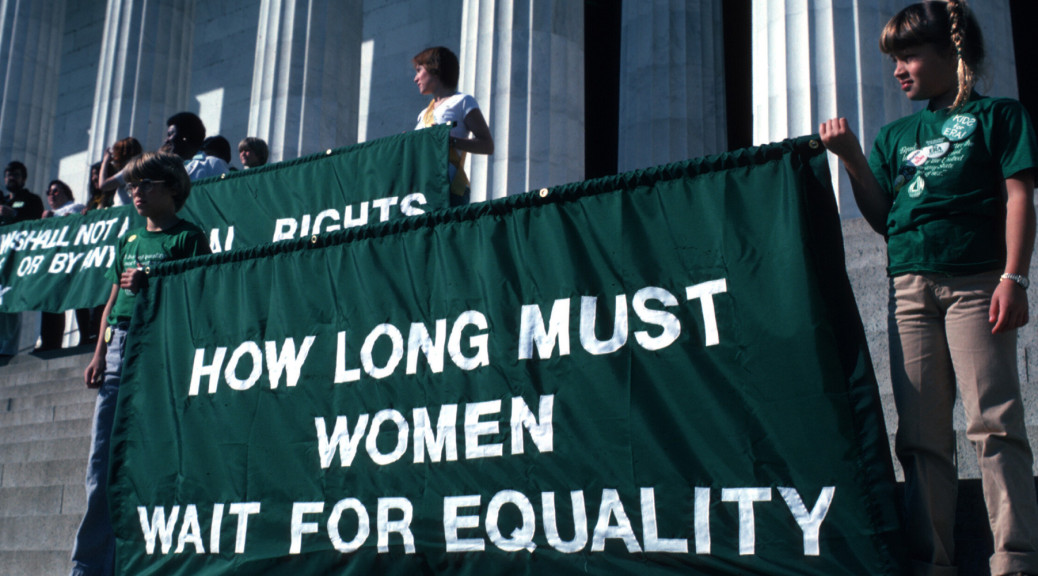
In discussions after the movie, we talked about the Equal Rights Amendment, which both of us fought for in the 1970s. It passed in Congress but, like any constitutional amendment, it had to be ratified in the states. We came close but we didn’t win, or rather we haven’t won yet.

The ERA would have overturned all the many statutes and case precedents justifying gender discrimination in America. Ginsberg’s approach, in the movie, was to tackle them one-by-one, and that’s what she and others have been doing. The movie implies that we’ve been winning all this time and will continue winning until gender equality is fully achieved.

But, so far, it hasn’t happened.

Why Not?

Women live longer and consequently outnumber men in America and on the planet. If they could get together, even vote together on women’s issues, they would win. But the truth is that they don’t.

Texas has had two outstanding women candidates for governor in the last two elections. Both were outstanding for their stands on women’s equality. Neither one of them won, and neither one of them got all of the women votes. I think that both of them, like Ruth Bader Ginsberg and maybe even like Hillary Clinton, made some progress; but so far no victory cigar!

Frederick Engels, in the 19th century, wrote that women were the first oppressed class, mostly because their oppression coincided with the birth of written history. Both written history and women’s oppression came about because surplus wealth was beginning to be produced. Men took that wealth and developed writing to account for it. They developed women’s oppression in order to make sure that their heirs were biologically theirs.

Engels said that women’s oppression would end in future society because women would be in the workforce and fully as productive as men. I think that’s been the case so far. The laws didn’t change first. What happened first was that women established their power and their rights in the workforce.

Union Women Are Far Ahead

Most American workers aren’t organized into unions, but the ones that are practice women’s equality rather thoroughly. As our working people attain more power, women’s equality will at long last attain its final goal.

Meantime, let’s keep marching!

–Gene Lantz

I’m on KNON’s Workers Beat program 89.3 FM in Dallas at 9 AM Central Time every Saturday. They podcast it on Itunes. If you are curious about what I really think, check out my personal web site

Today I posted a prologue and Chapter One of “Commissioner Torres and the New Government” on http://lilleskole.us, my personal web site. It’s actually my 4th book-length effort. One of them is autobiographical and covers just about everything I’ve learned so far.

What would your revolution look like?

The other three are speculative fiction about a guy named Leo Torres who gets involved with revolutionaries just when the old order of things has fallen apart. Leo gets in on the revolution from the ground floor.

Why?

You may wonder why I write and post these things. Obviously, I’m not going to make any money. They aren’t even copyrighted. It’s not because of the silly old shibboleth “Writers write because they have to.”

I’m one of many people who would like to see a better world, but I’m one of the very few who have tried to describe it. For decades I’ve dodged the question the same way almost every activist does by saying, “I don’t know what the world I’m fighting for would look like, because it’s up to those people living in that world to decide for themselves.” It may be true, but it’s still a dodge.

If we’re fighting for a better world, we ought to be able to describe it. Or at least we ought to try.

I decided on speculative fiction as my way of initiating a discussion on what might happen and what we might do about it. After all, does anybody think that we’ll just wake up one day in a better world?

Nearly all of our sci-fi is dystopian. Just about the only exception is the Star Trek series. They didn’t even have a revolution to get into their wonderful world. They just listened to the Vulcans. In one episode, Mister Spock hints that the Vulcans had to go through some very trying times before they became so civil, but he doesn’t tell us much about it. So we actually have no pattern to follow.

For a long time, American activists tried to copy the Russian revolution. When it imploded, a lot of them were disgusted and demoralized. Some others have tried to follow Chairman Mao. Some followed Nkrumah, Ho Chi Minh, and some followed Castro. I think we could learn from all of them, but we couldn’t learn enough. We have to do a lot of our own thinking.

So, we speculate.

The World I Made

Looking toward the future, especially in the Donald Trump era, one can see disaster ahead. It’s not a matter of whether or not the planet will become inhabitable and wealth inequality will make economic life impossible. It’s only a matter of when.

But I have great faith in myself and other people. Sooner or later we will give up on the people who are destroying the economy and the ecology. We will embrace new leaders and new ways of running things. In the world I create in my sci-fi novels, people have just recently done that. Following the advice of revolutionaries, civilized people have disbanded their armies and their police. They formed local militias to keep order while respected and capable leaders are elected to make economic and social decisions.

The revolutionaries at the center help coordinate activities and continue to advise the localities. As you might imagine, there is very little continuity between one locality and another. There are a tremendous number of problems to be resolved. What will people eat? How will they get it? How will trade continue? How will people get from one place to the next?

Because the air and water are almost undrinkable and unbreathable, something drastic has to be done about the burning of fossil fuels. Because all systems are down, there is no electricity. Without electricity and transportation, there is no long-distance communication. Without transportation, people will not be able to get the goods and services they need to stay alive. What would you do about those things?

The first two novels take the easy way out. They only deal with some of the smaller questions.

My first novel deals with whether or not revolution is possible and worthwhile. It’s common to hear it said that humanity isn’t worth saving, that people will never learn to live without war, that people are essentially greedy and incapable of cooperation, and that every revolution has failed because people are basically just no damned good!

My second novel is more specific. It tries to deal with the fact that certain sectors of the population will not cooperate in building a better world. Hardened drug addicts, for example, are unlikely to cooperate in civil society. What would you do with them?

The third novel is by far the most ambitious. It recognizes that government is necessary and begins to discuss the ins and outs of setting up and running such a government. Is democracy the answer? If so, what would be the machinery of democracy? Here’s a really thorny question, “How could a society avoid the tyranny of the majority?”

I don’t know if you can answer these questions, but I know that I can’t. But I’m inviting you to join me in trying to find out.

–Gene Lantz

I’m on KNON radio’s “Workers Beat” talk show 89.3 FM in Dallas at 9 AM every Saturday. Call in 972-647-1893 with your ideas. They podcast it on Itunes. If you are curious about what I really think, check out my personal web site at http://lilleskole.us

Texans are forever taking their children to see the Alamo, and a lot of them go to the San Jacinto Battlefield. But if they really care about Texas history, they should make a pilgrimage to Crystal City, where ordinary working people made a lot of history.

Crystal City was the site of the biggest concentration camp of World War II. Japanese families were there from 1943 through the end of the war. A few Italians and Germans were also sent there from other parts of the U.S. and Latin America. The United States traded them for our own prisoners of war.

Crystal is also a great civil rights site. The Chicano movement that terrified Anglos in the 1970s began in Crystal City. The struggles of some of the most desperate working families in America took place in Crystal City. For a while there, they won!

I think it was in 1963 that five very courageous Latinos took city government power from the dominant Anglos. With only 10% of the population, Anglos had always dominated everything. Then in 1969, Juan Campeon and Jose Angel Gutierrez convened La Raza Unida Party at Salon Campestre just outside the city limits and on the banks of the Nueces River.

La Raza Unida soon took over government in all of Zavala County and in surrounding counties. Inspired by La Raza, other Chicanos throughout America began to form their own fighting civil rights organizations.

Today, only the cement steps of the old Salon Campestre remain. There are no historical markers for La Raza Unida. They hold no government offices, but Mexican American Democrats and other organizations owe their initial inspiration to the courageous workers of Crystal City. There’s a great play about it. It’s named “Crystal.”

About 8,000 people, nearly all Mexican Americans, live in Crystal. A branch of the historic Nueces river runs (when there is enough water) just outside the city limits. There are no unions in existence, even though the CIO tried in the 1940s and the Teamsters tried in the 1960s to organize the cannery workers.

There are no museums in Crystal City. The library is closed. There are several statues of Popeye the Sailor Man and some claims to be the Spinach Capital of the World, but the great contributions and sacrifices of working families are noted only in the minds of certain Chicanos and a handful of amateur historians like us, who care about real history.

–Gene Lantz

I’m on KNON’s “Workers Beat” talk show 89.3 FM in Dallas every Saturday at 9 AM Central Time. If you are curious about what I really think, check out my personal web site